
Robotic Press Feeds & ISO 13849-1 Cat 4 Safety Circuits
for Tier 2/3 Automotive Lines
MCSL Technical Services designs, retrofits, and commissions high-precision automation systems for Tier 2 and Tier 3 automotive component manufacturers, commercial vehicle builders, and EV skids across Dubai Industrial City, Abu Dhabi KEZAD, and the GCC. Since 2013, we have engineered robotic assembly cells, poka-yoke stations, and IATF 16949 compliant PLC architectures.
Our Dubai-based automotive controls team guarantees Cpk ≥ 1.67 process capability, end-to-end component traceability, and automated PPAP Level 3 compliance data capture.
.jpg)




Why Tier 2/3 Automotive Suppliers Need Specialized Automation
Automotive supply chain manufacturing runs on repeatability. Tier 1 and OEM customers set cycle time and quality targets that leave little room for variation, and a process that works most of the time is not good enough when the requirement is consistency on every single part.
Thinner In-House Resources
Tier 2 and Tier 3 suppliers operate with leaner internal engineering teams than the Tier 1s setting the targets. Automation must bridge this gap and stabilize lines without requiring armies of programmers.
IATF 16949 Flow-Down Pressure
Core tools (APQP, PPAP, FMEA, MSA, SPC) flow directly down the sub-tier supply base. A supplier assuming these stay at Tier 1 faces severe audit exposure and containment risks.
Cpk & Launch Containment Risks
A single failed PPAP submission or a process capability index (Cpk) that slips below target can delay a program launch, trigger a costly containment event, and damage customer trust.
Every Process Needs Data
Visual inspection alone no longer satisfies OEMs. Every torque rundown, press-fit force, and leak rate needs verifiable data logged behind it for complete part traceability.

Supporting precision component manufacturers, press shops, commercial vehicle converters, and subassembly suppliers across UAE industrial corridors and Saudi Arabia.
The UAE & GCC Automotive Supply
Chain Landscape
The automotive manufacturing landscape in the UAE and Saudi Arabia is rapidly evolving through major investments in commercial vehicle manufacturing, armored defense fleets, bus assembly, and electric vehicle (EV) ecosystems. In hubs like Dubai Industrial City, KEZAD, and Saudi industrial clusters, Tier 2 and Tier 3 suppliers provide critical stamped components, wiring harnesses, specialized chassis fittings, and subassemblies.
These component suppliers face exacting requirements from global OEMs and government defense integrators, where zero-defect manufacturing, real-time Cpk process stability, and automated poka-yoke interlocking are mandatory.
Automotive supply chain manufacturers need engineers who understand high-speed PLC automation, robotic kinematics, and the rigorous documentation discipline that IATF 16949 and PPAP demand.
MCSL Technical Services bridges this gap by delivering turnkey automotive automation, robotic welding skids, and automated inspection stations backed by complete PPAP Level 3 documentation.
Signs Your Line Needs Automotive-Grade Automation
Several recurring signals tell us a Tier 2 or Tier 3 automotive supplier is ready for an automation review before risks escalate into customer containment or launch delays:
Inconsistent Cpk Process Stability
Manual or semi-manual assembly processes are struggling to hold strict customer Cpk capability targets consistently across high-volume production runs.
PPAP Documentation Delays
PPAP submissions are getting held up or rejected due to missing documentation trails, unverified cycle logs, or lack of automated data capture.
Recurring Customer Containment Flags
Containment events or customer scorecard penalty flags keep recurring, tied directly to human assembly variability rather than raw material defects.
Absence of Shop-Floor SPC Telemetry
Your production floor lacks real-time Statistical Process Control (SPC) connectivity, leaving managers reliant on delayed end-of-shift scrap audits.
In-House Engineering Capacity Strain
Your internal engineering staff is stretched thin across multiple OEM programs at once, lacking the capacity to optimize active lines.
Imminent New Program Launch Risks
A major new automotive program launch is approaching, and your facility lacks the dedicated controls engineering capacity to build and commission the cells.
Struggling with Cpk capability or upcoming PPAP milestones?
An automation review is worth prioritizing before customer scorecards or program launches are affected.
Our Automotive Automation Services
From high-speed assembly PLC logic to heavy-duty multi-shift control panels, integrated vision inspection, and live SPC dashboards, we engineer systems that hold process capability on every single cycle.
PLC Programming & Control Systems
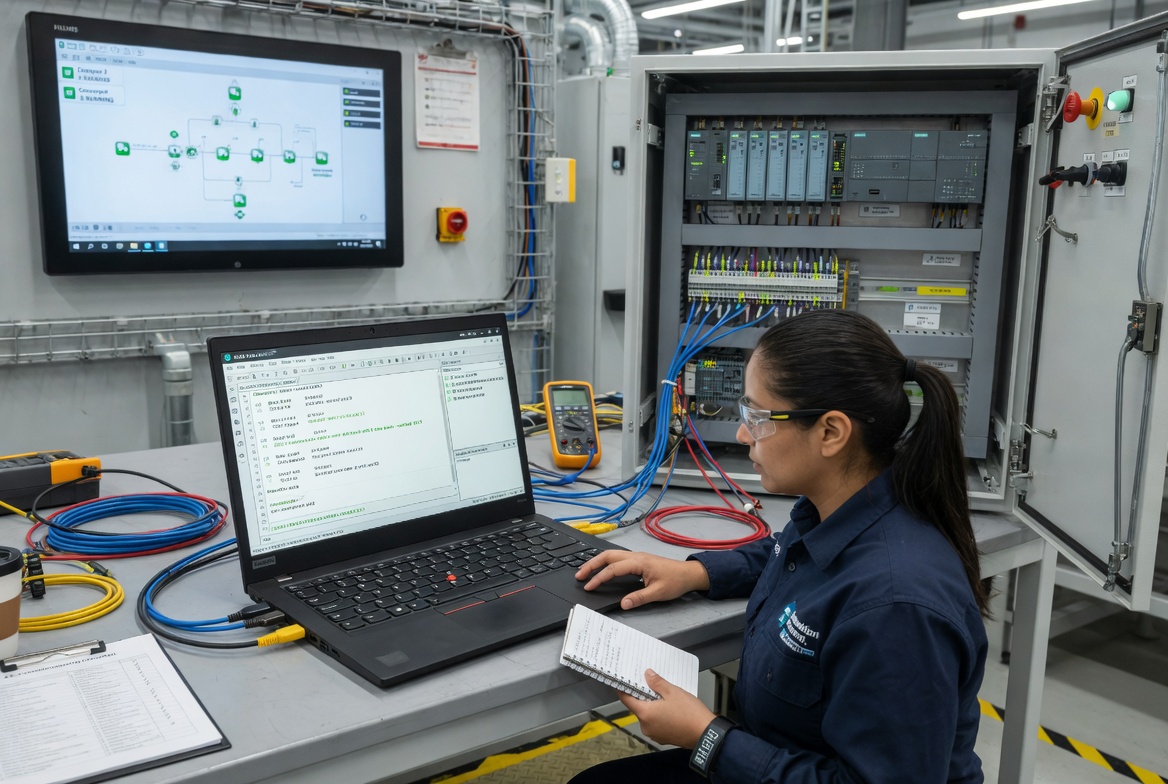
We engineer robust control logic tailored specifically for complex assembly, testing, and inspection stations. By leveraging platforms like Siemens, Mitsubishi, and Unitronics, we create automation solutions that prioritize the high-frequency repeatability required by automotive OEMs. Our programming approach ensures consistent cycle times and rigorous process stability, helping Tier 2/3 suppliers meet demanding production targets without the variability that often plagues manual or legacy systems.
Electrical Control Panel Design & Build
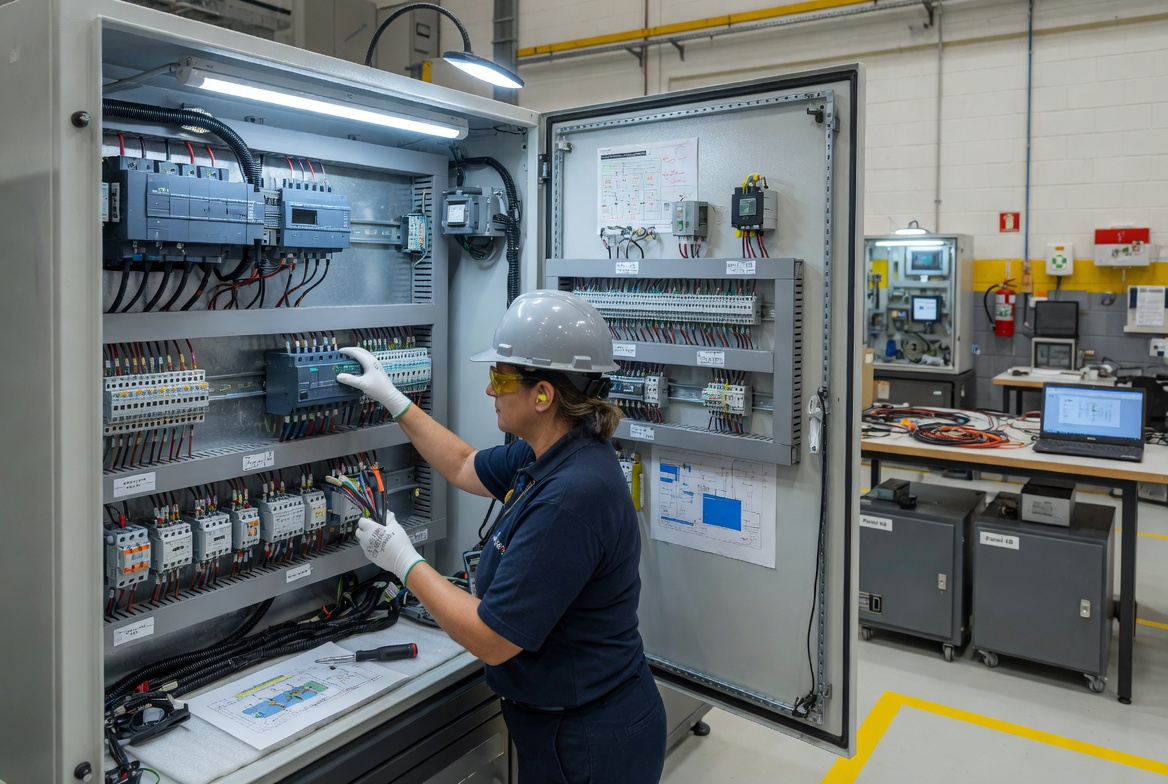
Our control panel design and manufacturing process is engineered for the high-duty cycles of automotive supply chain environments. We build panels that withstand the demands of continuous, multi-shift production, ensuring electrical integrity and component longevity. By focusing on high-quality materials and thoughtful layout, we deliver panels that simplify maintenance and support, providing a reliable backbone for your automation lines while meeting necessary industrial standards.

Systems Integration
We seamlessly integrate critical quality verification processes such as torque monitoring, leak testing, and automated vision inspection directly into your production line. By coordinating these functions within your control architecture, we shift quality control from a reactive, end-of-line task to an active, in-process activity. This integration minimizes the risk of non-conforming parts reaching the next tier and provides the precise, real-time data flow needed for modern traceability requirements.
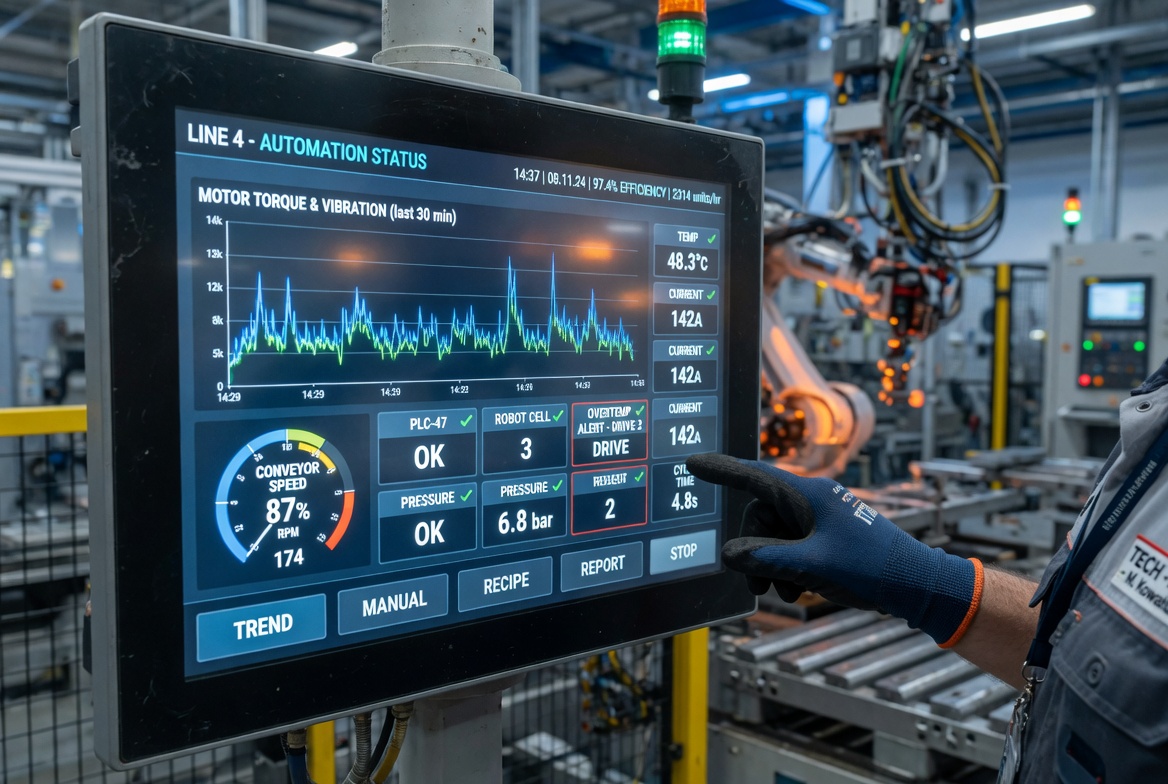
HMI & SCADA Development
We design intuitive operator interfaces that act as the command center for your production assets, featuring integrated Statistical Process Control (SPC) visibility. Instead of relying on delayed end-of-shift reports, your team gains real-time insight into process capability (Cpk) directly on the shop floor. This immediate data access empowers operators to spot deviations and adjust processes proactively, ensuring you maintain control over product quality and program launch requirements.

Remote Monitoring & Diagnostics
Our remote monitoring solutions offer continuous, real-time diagnostics for your assembly, test, and auxiliary machinery. By tracking key performance indicators and equipment health, we help you protect uptime and honor customer-committed cycle times. This proactive approach identifies developing faults long before they result in downtime, ensuring your facility remains a dependable partner in the automotive supply chain and avoids critical supply interruptions.
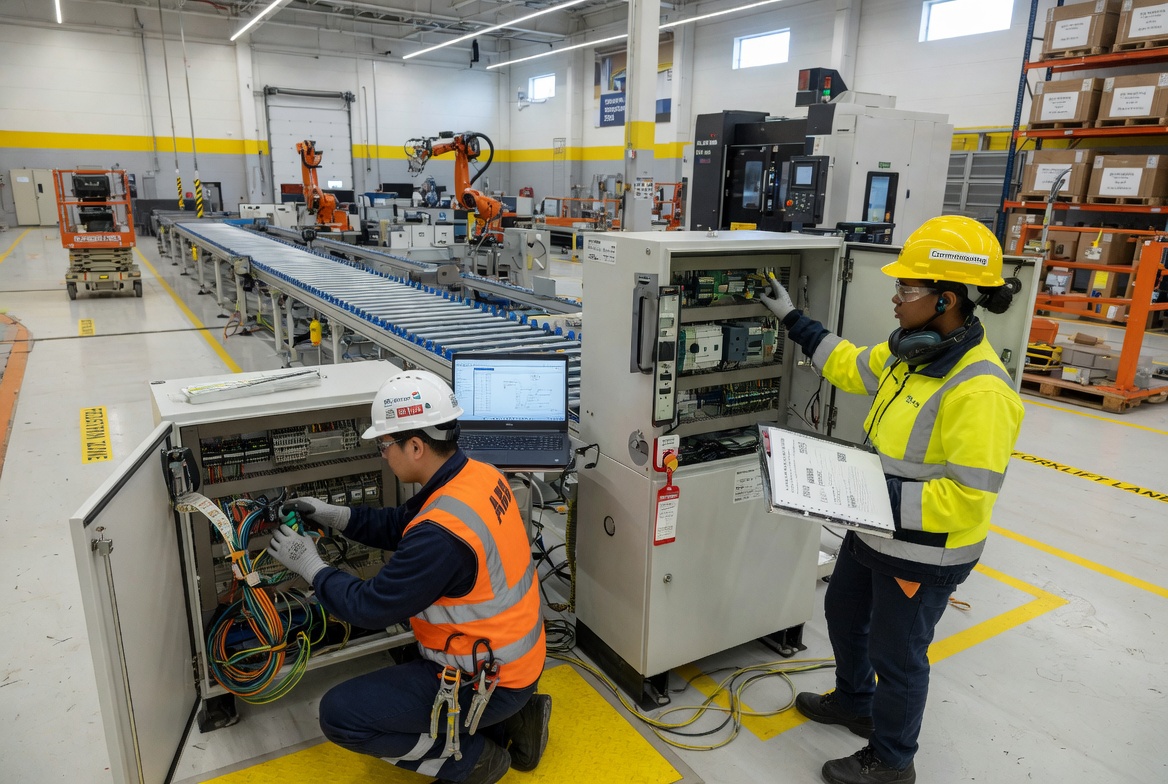
Installation & Commissioning
We deliver systems that are fully PPAP-ready from day one, ensuring your documentation and performance validation are complete before handover. Our commissioning process includes thorough testing and data verification, so your submission process is never delayed by missing documentation or unproven process metrics. We manage the entire deployment, from installation to operator training, ensuring a smooth transition that allows you to focus on production volume and quality.
Supporting IATF 16949 Compliance and PPAP Readiness
IATF 16949's core tools exist to build process discipline, not to generate paperwork for its own sake. We design our automation systems to feed these requirements automatically rather than forcing your team to reconstruct data manually after the fact.
APQP (Advanced Product Quality Planning)
Automation architecture structured from the initial concept to align with your program milestones and gate reviews, eliminating launch delays.
PPAP (Production Part Approval Process)
Automated generation of process capability data, machine run charts, and calibration records ready for immediate customer submission.
FMEA (Failure Mode and Effects Analysis)
Hardware interlocks and software poka-yoke routines designed specifically to address and prevent identified process failure modes.
MSA (Measurement Systems Analysis)
Integrated inspection stations with high-resolution digital sensors designed to pass rigorous Gage R&R repeatability and reproducibility audits.
SPC (Statistical Process Control)
Live Cpk and Ppk calculations embedded directly in the PLC/HMI, alerting operators to process drift before out-of-spec parts can be produced.
Traceability & Part Serialization
Every assembly timestamped and linked to its exact torque curve, leak test value, and vision inspection image for total audit defense.
Every system we build includes the data traceability needed to connect a finished part back to the process, the equipment, and the inspection result that produced it. This is the difference between a PPAP submission that moves smoothly through customer review and one that gets held up on a documentation gap that had nothing to do with the actual quality of the part.
Supporting Automotive Suppliers Across the GCC & Worldwide
Headquartered in Dubai, UAE, we apply world-class engineering discipline and IATF 16949 compliant design processes to automotive component manufacturing and EV skids across the Middle East.
Whether your facility supplies regional vehicle builders or global Tier 1 programs, you receive the same rigorous process, certified quality management systems, and dedicated lifecycle support.
Rapid mobilization to Dubai Industrial City, KEZAD, and Saudi automotive clusters for scheduled cell upgrades, cycle time optimization, and shift support.
Complete automated assembly and test cells built and tested to PPAP standards in-house, then shipped for on-site commissioning across international supplier networks.
Real-time remote diagnostics tracking torque curves, cycle times, and reject rates to catch equipment wear long before it causes an at-line shutdown.
How We Work
We follow a structured, documentation-aware process on every automotive automation project:
Consultation & Line Audit
We assess your current process, customer cycle time targets, Cpk expectations, and program launch milestones before designing.
System Design & FMEA
Our engineers develop CAD electrical schematics, mechanical integration models, and control software built around error-proofing.
Build & In-House FAT
We manufacture panels and build control logic in-house, completing full Factory Acceptance Testing and generating initial capability data.
Commissioning & PPAP Study
We install on-site, execute short-run capability trials, verify Gage R&R, and train your staff, maintaining complete records throughout.
Lifecycle Support & Telemetry
We provide ongoing preventative servicing, remote monitoring, and continuous improvement support to protect Cpk over program life.
Why Manufacturers Choose MASK for
Automotive Automation
We hold ISO 9001, ISO 17020, and ISO 17025 certifications, and we bring that same quality management discipline to every automotive project we take on. Our team works across Siemens, Mitsubishi, Unitronics, Allen-Bradley, and Omron platforms, so we recommend the right technology for your line rather than defaulting to a single vendor's equipment.
We manage every project end to end, from initial design through build, installation, commissioning, and ongoing support, so you work with one accountable engineering partner rather than coordinating multiple contractors.
As the shortage of engineers who understand both automation and IATF-driven documentation continues to affect the sector, we act as an experienced outsourced team who already understands the pressure Tier 2 and Tier 3 suppliers operate under.
Tri-Certified Quality Framework
ISO 9001, ISO 17020, and ISO 17025 certified quality management protocols applied to all panel manufacturing, software verification, and sensor calibration.
Vendor-Agnostic Objectivity
Specialist expertise across Siemens SIMATIC, Mitsubishi MELSEC, Unitronics, Rockwell, and Omron controllers to match your OEM plant specifications.
Single Accountable Partner
End-to-end delivery from initial concept and electrical schematics to on-site PPAP runs and 24/7 technical breakdown support under one accountable roof.
Bridging the Automotive Skills Gap
Immediate access to senior controls engineers who understand both PLC logic and IATF 16949 core tool documentation discipline.
Frequently Asked Questions
Key questions Tier 2 and Tier 3 automotive component manufacturers ask when evaluating MCSL Technical Services:
Frequently Asked Questions
Everything you need to know about our engineering standards, local UAE delivery, and technical capabilities across the Middle East.
We engineer PLC control logic and SCADA tracking that automatically generate required PPAP Level 3 documentation. Every assembly fixture captures cycle-by-cycle torque curves, angle limits, pressing force profiles, and vision pass/fail results into SQL databases with full serialization and 10-year audit traceability.
We serve commercial vehicle body builders, specialty military and armored vehicle fabricators, bus manufacturers, EV retrofitting skids, and precision Tier 2/3 metal stamping, casting, and injection molding facilities across Dubai Industrial City, Sharjah, Abu Dhabi KEZAD, and Saudi Arabia.
Yes. We engineer turnkey robotic automation cells utilizing KUKA, ABB, Fanuc, and Yaskawa industrial articulated robots. We integrate laser-guided seam tracking, automated dual-component polyurethane adhesive dispensing, automated screw-driving, and optical inspection compliant with ISO 10218-1/2 safety interlocks.
We integrate smart sensor interlocking, light curtain pick-to-light sequences, barcode/RFID part verification, and pneumatic tooling clamp locks that physically prevent the machine from releasing the part until all torque values, clip insertions, and dimensional checks satisfy strict Cpk > 1.67 criteria.
Yes. We minimize disruption to OEM delivery commitments by pre-wiring and pre-testing control panels at our Dubai facility and simulating I/O sequencing on digital twins before site installation. Mechanical and electrical changeovers are completed during scheduled shutdowns.
Yes. Our Dubai-based automation engineers provide 24/7 emergency response across UAE industrial zones and GCC automotive manufacturing corridors, supported by 15-minute secure VPN remote diagnostics.
Have a specific technical question for your UAE factory or facility?
Explore Other Industries We Serve
In addition to automotive component manufacturing, MASK engineers bespoke control and automation systems across diverse industrial sectors:
Get In Touch With Our Automotive Controls Engineers
If you are planning an automotive automation project, or you need to close a compliance or capacity gap ahead of a program launch, our team is ready to help. Explore our other industry sectors or contact us directly to discuss your requirements.